

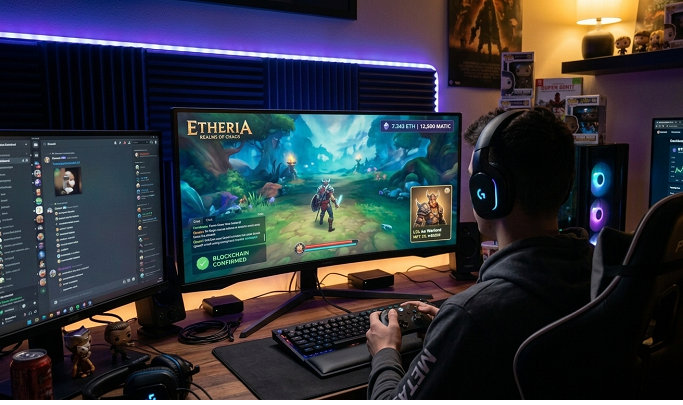
As web3 gaming crosses the $48 billion mark in 2026, Yat Siu of Animoca Brands argues that web3 gaming is no longer won by the studios with the biggest budgets, but by low-fee blockchains that make the infrastructure cheap enough to turn every in-game trade into a provable act of digital ownership, quietly rewiring the entire gaming economy from the ground up.
Low-fee blockchains are replacing big studios as the real power, digital ownership is finally working at scale, and the gaming economy is shifting from spectacle to plumbing.
Yat Siu got into gaming in the 1980s. He never really left. Today, as co-founder and chairman of Animoca Brands, the Hong Kong-based venture firm with over 600 web3 gaming investments, he watches most of the industry argue loudly about the wrong things.
“People often confuse the concept of scarcity simply by the quantum of an asset,” Yat Siu said. “They say there’s only this much, and therefore it’s scarce. While that is a practical definition of scarcity, that is not what we pay for.”
That single sentence cuts to the heart of why most AAA studios failed at blockchain gaming and why a quiet revolution in blockchain infrastructure is now reshaping the entire gaming economy. Yat Siu’s argument is straightforward: value in web3 gaming does not come from asset scarcity.
It comes from whether those assets are provably, authentically yours. And proving that authenticity at massive scale requires cheap, fast, invisible rails, the kind that low-fee blockchains now provide.
The Wrong Fight, For Too Long
For years, the web3 gaming debate was a spectacular distraction. Critics called it a scam. Fans swore it would destroy Fortnite. Billion-dollar studios built NFT storefronts on congested Ethereum mainnet and called it the future of digital ownership.
None of it worked. A $20 gas fee on a $5 in-game sword is not a gaming economy. It is a punchline.
Meanwhile, Yat Siu and Animoca Brands were placing bets on something far less glamorous and far more important. The blockchain infrastructure underneath the games. The low-fee blockchains could settle millions of microtransactions cheaply and instantly. The chains that made the gaming economy function like an actual economy.
Those chains are now winning.
Fractions of a Cent, Billions of Transactions
The numbers speak clearly. Networks like opBNB, Ronin, Immutable zkEVM, WAX, and Kaia now process in-game transactions at under $0.01 each. opBNB handles over 5,000 transactions per second. Kaia saw active wallets surge 229 percent in a single quarter. Ronin hit 2 million daily active users in a single day in 2024, briefly outpacing Tron and Solana, and now has 20.9 million total wallets.
Consequently, the web3 gaming market reached $48.55 billion in 2026 and is projected to hit $108 billion by 2030. That growth runs entirely on low-fee blockchains, not on Ethereum mainnet, and certainly not on a AAA studio’s press release.
Yat Siu frames the mechanism precisely. “The authenticity is becoming more precious today because you have so much abundance,” he said.
When every trade and transfer lands on blockchain infrastructure at near-zero cost, every transaction becomes a permanent, provable record of who owns what. That is not a technical footnote. That is the entire value proposition of digital ownership in gaming.
What the Big Studios Fundamentally Misunderstood
Here is the hard truth for big publishers. Ubisoft, Square Enix, and EA did not fail at web3 gaming because players rejected digital ownership. They failed because they treated blockchain infrastructure as a marketing layer rather than as a financial backbone.
Siu uses the Mona Lisa to explain what they missed. “What makes the painting valuable isn’t that it’s just one,” he said.
“What makes it valuable is that it is authentically from Leonardo da Vinci and it is one.” Similarly, anyone can clone a Fortnite skin using AI in under a minute. However, without Fortnite’s authentication, that skin has, as Yat Siu puts it, “value of zero.”
Therefore, what gaming economy builders actually need from blockchain infrastructure is not a lock on scarcity. It is a cheap, scalable, permanent proof of authenticity. Studios building on expensive chains broke the economics. Studios building on low-fee blockchains kept them intact.
AI Makes the Rails More Important, Not Less
Furthermore, Siu pushes the argument further into the AI era, and it gets sharper, not softer.
“In a world where there are agents everywhere, you need to prove authenticity even more so,” he said. As AI floods web3 gaming markets with infinite synthetic assets, infinite skins, and AI-generated worlds, the gaming economy needs a reliable, affordable way to separate the real from the replicated.
Blockchain infrastructure becomes the authentication engine. Low-fee blockchains make that engine fast enough and cheap enough to run at a human scale.
Animoca Brands’ own agentic AI platform, Animoca Minds, is already building on this logic, deploying AI agents that hold wallets, execute on-chain transactions, and settle payments among themselves using blockchain rails, because credit cards and banks cannot handle the transaction volume AI agents demand.
Asia Rewrites the Rulebook
Additionally, the geographic story of web3 gaming points directly at blockchain infrastructure as the decisive variable. Asia-Pacific grows at 21.27 percent annually through 2033 and hosts 1.5 billion gamers.
South Korea, Japan, India, and Vietnam lead adoption — all markets where players demand low friction on principle.
A Korean player in a PC bang closes an app before paying a $3 fee to the blockchain to sell a weapon. Chains that solved that problem, opBNB, Ronin, and Kaia, now dominate the gaming economy across East and Southeast Asia.
Animoca Brands holds major portfolio positions across all three regions, and Siu’s view of Asia as the proving ground for low-fee digital ownership infrastructure has aged extremely well.
The Stack Always Beats the Screen
The uncomfortable truth for every gamer and investor watching this space: the most powerful company in web3 gaming over the next decade will probably never ship a single title. It will run the blockchain infrastructure every game runs on, processing millions of microtransactions invisibly, provably, and cheaply.
WAX processed 687 million gaming transactions in a single quarter. Ronin is deploying zkEVM to onboard the next wave of studios. The gaming economy has moved from the screen to the stack.
Yat Siu has been saying it since the beginning.
“What makes it valuable is that it is authentically from, and it is one.” In 2026, the chains that make that proof cheapest to deliver are the ones deciding which web3 gaming worlds survive, and which ones disappear.
Get the hottest news on upcoming game releases, patch updates, and gaming industry trends, stay updated with KoreaGameDesk on Twitter, Facebook, Instagram and Linkedin
More from us:
- Darksword: Battle Eternity VR RPG Showcased at Gamescom
- EOAG Games’ mobile games are topping app store charts & gaining worldwide users
- Mageseeker, a League of Legends spin-off leaked by Korean rating agency
- Soulgames, Elevating Gaming with Unique MMORPG at Gamescom
- NCSoft’s Throne and Liberty Revolutionizes Gaming Monetization, Shifts Away from Gacha Systems