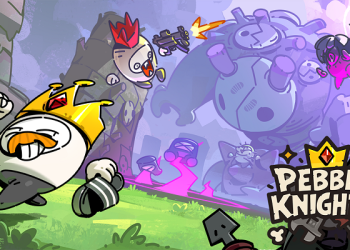


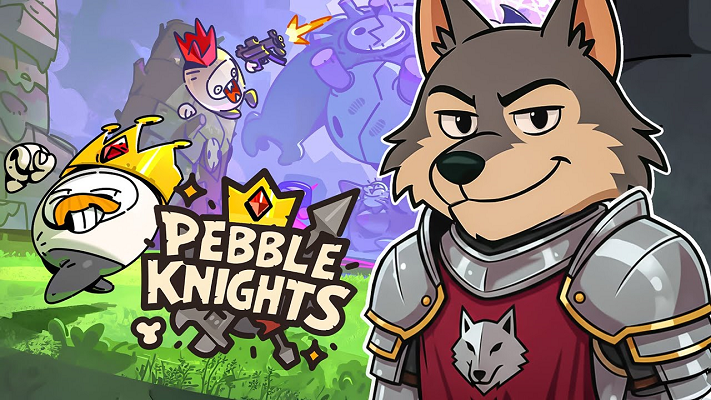
When Pebble Knights launched on Steam Early Access on April 13, 2026, this Korean indie game dropped into the cooperative roguelike space without much pomp and posh, just a 323 percent crowdfunding win, Steam Early Access momentum, a Gyeonggi Game Audition backing, and KOCCA game support that signals South Korea means serious business in global gaming.
Seoul-based studio 51 Percent Games built Pebble Knights around a deceptively simple premise. Five players, one shared survival run, and every decision matters. Teams navigate procedurally generated combat, divide roles, and adapt strategy on the fly.
The Early Access version already expands dramatically on the earlier demo, unlocking the “Underworld” region after Day 15, complete with 23 new bosses and 18 event rooms engineered specifically around cooperative dynamics.
This isn’t a game where multiplayer is an afterthought. It is the architecture. Five is not a random number; it maps directly to the size of real friend groups, and 51 Percent Games made that social reality the foundation of every design decision in this cooperative roguelike.
Moreover, the studio has shipped updates daily since launch. Within days, update v0.1.2 landed, built directly from Steam community feedback. For a small indie team, that update cadence signals something important: the developers treat Early Access as a co-development contract with players, not a soft launch with a “coming soon” tag.
We are launching in Early Access to involve the community in shaping the game during development. The core gameplay is complete and fully playable, but we plan to expand content, improve balance, and refine systems based on player feedback. Early Access will help us prioritize features and deliver a more polished full release,” Choi Jin, the Program Director of the Game, told KoreaGameDesk.
The Pipeline Nobody’s Talking About
Here is where Pebble Knights becomes a much bigger story than its Steam page suggests.
The game was selected for the Gyeonggi Game Audition’s follow-up support program, one of South Korea’s most competitive regional game development initiatives, offering QA assistance, sound production, translation support, marketing support, and a prize pool of KRW 200 million.
Furthermore, this program feeds into a national network of 12 Global Game Centers operating across Gyeonggi, Busan, Jeonnam, and beyond, each one wired to move studios from prototype to export-ready product.
Behind that sits Korea Creative Content Agency (KOCCA), South Korea’s creative content authority, which has committed KRW 23.6 billion across approximately 82 projects for 2026 alone. A new KRW 2.7 billion track specifically targets AI integration in games.
Additionally, the government has allocated KRW 7.5 billion to push AI technology adoption across the sector, while a KRW 1 trillion National Growth Fund backs the broader media and content industry. South Korea has explicitly positioned K-games alongside AI and biotech as the next generation of national growth engines.
Pebble Knights sits squarely inside this machine.
What Tumblbug Proved Before Steam Could
Before a single Steam review was posted, Pebble Knights ran a campaign on Tumblbug, South Korea’s equivalent of Kickstarter, and raised over 300 percent of its funding target. That number deserves more attention than launch coverage has given it.
A 300 percent-plus domestic crowdfund is not a vanity metric. It functions as a market pre-validation test that reduces financial risk before global exposure.
Backers received limited-edition costumes, in-game naming rights, credits participation, and physical merchandise, giving them a material stake in the product’s success before launch day. Consequently, those backers became early advocates rather than passive consumers.
This model, validated at home on Tumblbug, refined through KOCCA or Gyeonggi support, and then shipped globally on Steam, is replicable. If Pebble Knights sustains its arc, it could become the standard first step for every K-indie developer eyeing a global audience.
Why Cooperative, and Why Now
Choosing a 5-player cooperative roguelike in 2026 is a deliberate genre bet. Cooperative multiplayer has grown steadily on Steam, and social gaming now defines how younger audiences play — together, not alone. Pebble Knights targets that behavior by design.
This is also a meaningful break from what Korean game development traditionally exported: MMORPGs, mobile gacha systems, and franchise IP like the Lineage series.
Those titles generated enormous domestic revenue but repeatedly struggled to cross cultural barriers globally. By contrast, a cooperative roguelike competes on universal terms: fun, replayability, and the quality of what happens when five friends play together.
There is no legacy baggage here. There is just a genre built for the moment. and a studio built for the pipeline.
The Real Test Is Ahead
Pebble Knights has launched with 1,800+ peak concurrent users, 17-language support, and a developer publicly committed to community-driven iteration. 51 Percent Games has stated plainly that “the core gameplay is complete and fully playable,” and that Early Access exists to expand content, improve balance, and refine systems before the full 1.0 release.
Nevertheless, five-player cooperative games are difficult to sustain. Retention depends on healthy matchmaking, content volume, community growth, and a fair progression economy, all of which strain small teams. 51 Percent Games is talented. Whether the studio is structurally resourced to manage that pressure is a different question.
“The demo gave players their first taste of what makes Pebble Knights distinct, the weapon-picking system, the rhythm of progression, and the satisfaction of watching a build come together. Early Access takes all of that and goes further,” said Choi Jin.
“We built on every piece of feedback the community shared during the demo period, squashed as many bugs as we could track down, and packed in experiences that reach well beyond the leveling loop. The fun does not stop when you hit the next milestone, it deepens,” he added.
Yet the stakes extend beyond one title. In 2025, Shape of Dreams by two-person studio Lizard Smoothie sold 500,000 copies in two weeks, proving K-indie solo projects could scale globally.
Pebble Knights now asks whether the same is true for cooperative team-based experiences, and whether the Korean indie pipeline that nurtured both games is ready to produce a new category of global hits.
Five players. One studio. An entire government-backed industry is watching.
Get the hottest news on upcoming game releases, patch updates, and gaming industry trends, stay updated with KoreaGameDesk on Twitter, Facebook, Instagram and Linkedin
More from us:
- Gacha RPGs like Nexon’s Blue Archive and Netmarbles’s Fate Grand Order slapped with R-18 rating for its graphic content
- Exploring the Excitement, Top 10 Upcoming Korean Games in the World of Online Gaming
- Unleash your inner hero with Alterium Shift on Steam’s early access
- Darksword: Battle Eternity VR RPG Showcased at Gamescom
- NCSoft’s Throne and Liberty Revolutionizes Gaming Monetization, Shifts Away from Gacha Systems