

Naoki Fujinaga, a 45-year-old solo developer from Japan with no prior game development experience, just shipped a commercial Diablo-like ARPG Fire Field on Steam in roughly three months using AI.
He did not use Unity. He did not use Unreal. He did not write a single line of code by hand. Rather than relying on traditional methods, he embraced AI as his main coding partner. He crafted a custom engine from the ground up and brought to life Fire Field, a dark fantasy isometric action RPG that captures the essence of the 1990s while incorporating the latest generative tools.
What he has accomplished is one of the clearest, most concrete signs yet that AI game development is no longer theoretical. It is live, playable, and already on Steam. KoreaGameDesk caught up with Naoki Fujinaga to know more about his gaming journey.
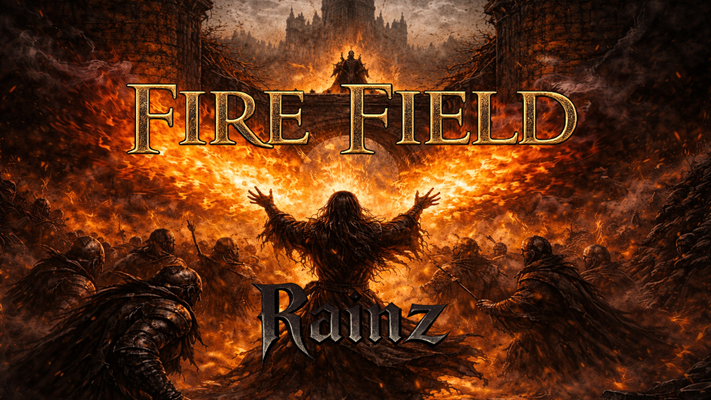
Fire Field is a dark fantasy action RPG where players descend into shifting underground dungeons, fight through gear-driven progression, and uncover the mystery of a flame that killed the king in 1997 and the figure known as Rainz.
The game is explicitly designed as a love letter to Diablo 1 and Ultima Online, with a retro-first approach that prioritizes the feeling of those games over modern conventions.
From Ultima Online to AI-Fueled Ambition
Fire Field was born from two distinct moments in Fujinaga’s life. The first came while he was playing Ultima Online in the late 1990s. Richard Garriott, the creator of Ultima Online, followed him on Twitter.
That interaction, combined with Fujinaga’s long-standing admiration for Garriott, planted the seed of making an original game tied to that legacy. For years, the idea simmered in the background, but it remained just that: an idea.
The turning point came when Fujinaga heard about Codex Mortis, a project that was reportedly built to a playable demo in three months using only AI. That story changed everything.
“If another developer could build something playable in that timeframe using AI, maybe I could do it too. I downloaded Claude Code and began working on what would become Fire Field,” Naoki Fujinaga said.
What followed was a three-month sprint that pushed him to the limits of his physical and mental endurance. He describes working around the clock, staying up all night coding, going to his day job, coming home for a short nap, and repeating the cycle.
Naoki slept about three hours a night. He wasn’t counting lines of code. He only learned that he had generated around 120,000 lines after someone asked him on X.
Building a Custom Engine and Map Editor from Scratch
“One of the most extraordinary aspects of Fire Field is that I built it without using any traditional game engine. Most solo developers, especially those working in the ARPG space, rely on Unity, Unreal, Godot, or GameMaker. I did none of that,” Fujinaga said.
Instead, he wrote his own editor in JavaScript and built a custom engine specifically for Fire Field.
He also built a custom map editor alongside the engine. This means he did not just rely on AI for code. He created the tools he needed to design and iterate the game himself. The engine, the editor, the gameplay systems, the UI, the combat, almost everything was built from the ground up, with AI as his primary partner.
This is a significant departure from the typical indie pipeline. It suggests that for certain types of projects, especially smaller-scope ARPGs with a retro aesthetic, AI can help a solo developer bypass the engine ecosystem entirely.
This does not indicate that engines are becoming obsolete. Rather, for some developers, AI is broadening the range of what can be built without dependence on an existing framework.
Code, Assets, Localization, and Beyond
Fujinaga’s AI workflow is unusually broad for a solo developer. He let AI handle code, assets, music, video, and even localization at a scale that would have been impossible for a single person without generative tools.
Code and Engine Development:
Claude Code generated the majority of Fire Field’s approximately 120,000 lines of code. Fujinaga describes himself as the director and integrator, reviewing, editing, and making design decisions while AI handled the heavy lifting of implementation.
This is not the same as pressing a button and getting a game. It is a continuous loop of prompting, testing, refining, and debugging, with the developer steering the project at every step.
The result is a fully functional game engine and codebase that would have taken years to build without AI. The fact that it was completed in three months by a solo developer with no prior game-dev experience makes Fire Field so compelling from an industry perspective.
Generative Art, Music, and Video
Alongside code, Fujinaga used AI tools to generate background and asset art, music and sound cues, and video content for trailers and marketing. These are areas that traditionally require specialized skills or outsourcing. Fire Field shows how a solo developer can now handle art, audio, and video in-house, with AI as a co-pilot.
This does not mean the visuals are indistinguishable from those of an AAA title. But for a retro-style isometric ARPG, the aesthetic is coherent and intentional. The game leans into a 90s-style look that matches Fujinaga’s vision of what Diablo 1 felt like, rather than competing with modern high-fidelity graphics.
95 Subtitle Languages, 70 Voice Dubs
One of the most ambitious parts of the project is the localization strategy. Fire field supports 95 subtitle languages and 70 dubbed languages. English is the default, but Japanese, Fujinaga’s native language, served as the quality benchmark. Native speakers verified the top 30–40 languages, with AI doing additional verification for the rest.
The technical challenge here is enormous. Manual verification of all 95 subtitle languages and 70 dubs is practically impossible for a solo developer. AI made the scale feasible, while human review ensured quality in key markets.
Korean support is especially prominent. Fire Field is fully Korean in both subtitles and voice dub for all dialogue. Fujinaga says Korea was a must-have target market because, in his view, Korea has been ahead of Japan in the ARPG and MMO space for a long time. The quality of Korean ARPG and MMO output has been extraordinary, and Korea was a clear target market from day one.
This level of localization is rare for a solo-built indie title. It is a direct reflection of how AI can enable a single developer to reach global audiences in ways that were once reserved for larger teams with dedicated localization budgets.
Bug Fixing and the Exponential Cost of Features
Despite the speed and AI assistance, Fujinaga says the hardest part of development was bug fixing. As he added more features, the number of bugs grew exponentially. He also admits there are probably still some bugs.
“This is a crucial detail for developers who might imagine AI as a magic bullet. AI can accelerate development, but it does not eliminate the core challenges of game development. Testing, debugging, balancing, and iteration are still required. The difference is that AI can reduce the time required to implement features and fix issues, but it does not eliminate the need for human oversight,” said Fujinaga.
His experience is a reminder that AI game development is not about replacing the developer. It is about giving the developer new leverage. The developer still has to make the decisions, review the output, and take responsibility for the final product.
Firefield, Rainz, and the Ultima Online Curse
The title of the game is deeply tied to its inspiration. Rainz killed Lord British in Ultima Online in 1997 using the spell Fire Field. That event is the origin of the game’s name. Fujinaga named the game after the spell and gave it the meaning of a curse inside the game world.
“This is a clever and memorable piece of branding. It ties the game to a recognizable moment in MMO history while still letting the title imply danger, curse, and flame within the fiction. For players who know the Ultima Online story, the name carries weight. For players who do not, it still sounds like a dark fantasy ARPG with a mysterious past,” he said.
The game embraces a nostalgic 90s isometric ARPG style while ensuring that you don’t need a high-end GPU to enjoy it. Fujinaga mentioned that Firefield can run on integrated graphics, so no dedicated GPU is necessary. Plus, it breaks down language barriers by supporting 95 subtitle languages and 70 dubs.
Solo Game Developers, AI Game Development, and the Future of Indie Gaming
Fire Field is making waves at a critical juncture in the industry. Thanks to the rise of AI-assisted development tools, especially code assistants like Claude Code, along with generative art and voice synthesis technologies, solo developers now have the power to tackle tasks that used to require small teams.
For years, the indie scene has been the playground for small teams and hobbyists. However, Firefield shows that AI is breaking new ground for solo developers.
Today, one individual can write and maintain an extensive codebase, create a custom engine and editor, generate art, music, and video, localize into multiple languages, and successfully launch a commercial product on platforms like Steam.
While this doesn’t mean every solo developer will instantly create AAA-quality games, it clearly signals a decrease in the barriers to entry for mid-scope projects, like an indie game similar to Diablo. The potential for creativity and innovation is expanding rapidly.
Get the hottest news on upcoming game releases, patch updates, and gaming industry trends, stay updated with KoreaGameDesk on Twitter, Facebook, Instagram and Linkedin
More from us:
- Assassin’s Creed Mirage: A Nod to the Past, Embracing the Future
- Unleash your inner hero with Alterium Shift on Steam’s early access
- Shadowlands Release Date: Everything We Know So Far
- Ubisoft delays Avatar: Frontiers of Pandora, cancels four other games
- Rocket League Sideswipe: Release date, APK download, system requirements