

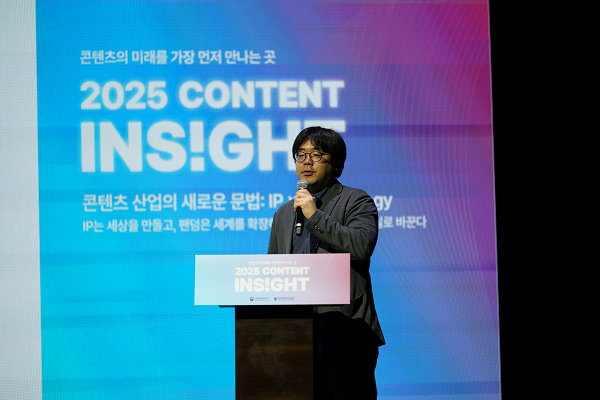
The $38 billion Japanese anime industry is approaching a critical turning point, said Shota Tanaka of DeNA, from the Korea Creative Content Agency (KOCCA) 2025 Content Insight stage. Speaking to an audience of more than 2,000 global creators, technologists, investors, and policymakers, Tanaka warned that the industry is struggling under severe production bottlenecks, soaring costs, and a business model dangerously reliant on a single revenue stream.
He said that while artificial intelligence could ease long-standing production pressures and reduce escalating expenses, the path to real profitability from AI-generated content remains uncertain.
Shota Tanaka’s remarks came during the 2025 Content Insight, held on November 6–7 in Seoul and hosted by the Ministry of Culture, Sports and Tourism and KOCCA. The event, themed “The New Grammar of the Content Industry: IP × Technology,” examined how storytelling, intellectual property, and AI are reshaping the global content landscape.
Despite the challenges, Tanaka pointed to early pockets of commercial success with AI-driven content, suggesting that the industry’s future may evolve sharply from its past. The numbers tell the story.
The Japanese anime market reached an estimated 3.8 trillion yen in total sales, with overseas revenue now accounting for the overwhelming majority of growth. Yet this explosive international success masks a fragile domestic dependency. Domestic revenue in Japan has remained relatively flat while overseas markets have driven nearly all expansion.
Animation has proven to be a global catalyst for Japanese IP monetization, but that catalyst is now failing.
The Bottleneck Is Absolute
Major animation studios are already booked solid through 2028–2029. The capacity constraint is not a temporary shortage but a structural limit.
“Even if you ask for a job, you can’t get it,” Tanaka said bluntly. “So even if you want to make a great novel or a great manga into an animation, it will probably take several years to make it into a TV animation. Even if it’s fast, it will take 2030, and if you start doing it now, it will be 2035.”
This timeline is devastating for IP publishers. In the manga and light novel business, most properties never become standalone bestsellers or franchises. Without anime adaptation, they languish as niche products.
Tanaka called this the “Royal Road”—the proven path by which manga are adapted into anime, which then triggers cascading monetization through streaming platforms, merchandise, gaming, and international licensing.
But the Royal Road now takes half a decade to travel.
The cost crisis adds urgency to the bottleneck. In 2015, a single 30-minute television anime episode cost approximately 15 million yen. In 2025, the same episode costs 30 million yen—exactly double. Premium productions now command 50 million yen or higher per episode. A standard 13-episode series now exceeds 600 million yen, or roughly $4 million USD.
“If you want to make a work that everyone knows well, it will cost you 50,000,000 yen or more,” Shota Tanaka said.
This inflation has created a critical industry vulnerability as the model now depends entirely on North American licensing revenue to close the gap between production costs and domestic revenue.
“We have a big reliance on the distribution or licensing in North America due to the increase in costs,” Tanaka said. “If this situation changes, we will not be able to make the animation because the cost is too high. The Royal Road will collapse,” he added.
Where Is the Real AI Revenue?
Despite widespread skepticism and heavy social pushback against AI in Japan, actual commercial revenue is flowing. Large Japanese publishers like Kadokawa, Kodansha, and Shogakukan have issued joint statements criticizing the use of AI to train on copyrighted material. Yet, at the same time, innovative AI character services and illustration generators are already generating measurable income.
“There are already sales of tens of millions of yen or more than 100 million yen a month in Japan,” Shota Tanaka said. “Even if there are so many discussions in the world, some of the innovative customers will pay money to AI or pay money to services related to AI.”
This is happening in what Tanaka described as a “hidden underground market where no one has official data.” The most striking success story is virtual YouTubers (VTubers). The market exploded from 1.4 billion yen in 2020 to over 1 trillion yen today.
It is roughly a sevenfold expansion in five years. The appeal is distinctive: “It is friendly like a friend. In other words, it is a streamer that you can see every day,” Tanaka noted. “And another point is that it is a fandom that celebrates the success of friends, such as having a live show, having an event, and selling goods.”
This insight is crucial for game companies and investors as the successful AI-driven content that is monetizing at scale today consists of daily-access characters that audiences feel a personal investment in—not attempts to extend existing blockbuster franchises with AI.
AI Luffy, a conversational artificial intelligence version of One Piece’s protagonist, represents official IP collaboration with AI.
“You can have a conversation with Monkey D Luffy from One Piece. This Luffy is actually a Shueisha lobbyist. He will answer your questions and even show you the way,” Shota Tanaka said. Yet monetization metrics for such projects remain absent from public disclosures.
The Paradox That’s Freezing the Industry
Tanaka expressed a paralyzing contradiction at the heart of Japan’s content industry. Publishers desperately want to deploy AI to reduce production costs and accelerate workflows, as nearly every major listed animation company is testing or using AI tools. Yet they must publicly oppose generative AI for fear of social backlash and copyright concerns.
“In fact, even if there are players who strongly believe that they want to increase productivity by using AI, it is an ambivalent situation in which they have to show a confrontational attitude towards AI for the world. This is becoming a huge problem for publishers, especially for companies that have to face manga artists and creators,” Tanaka said.
Manga artists themselves want to use AI for efficiency. Publishers representing them cannot say so publicly. “The society’s view of AI is becoming more and more dubious,” said Tanaka. “This is a trend that we are trying to avoid, but in large Japanese companies, it is better not to use the word generative AI in press releases. It’s better not to put it on the front page. Basically, we are trying to avoid it. This is because there are a lot of complaints and objections.”
This creates an opportunity for startups. “This is a huge chance for creators or startups. When a large number of companies cannot operate, the interest in the picture will increase.” Tanaka identified two distinct scenarios for AI’s role in anime and gaming IP. “One is that strong IPs will integrate AI and become even stronger. The other is that completely new IPs will emerge as new services in everyday life.”
The evidence suggests the second scenario is already winning on the commercial front. VTubers and social-media-native characters are generating real revenue. Established franchises attempting to use AI for extensions are still in the prototype phase.
This has immediate implications for game developers. The profitable AI-content wave appears to be coming from new characters designed for daily accessibility and personalization—not from attempts to resurrect aging properties with AI companions.
DeNA’s Hedge Against Industry Collapse

Rather than betting everything on solving the animation crisis, DeNA has deliberately built a diversified business model. The company operates the Yokohama DeNA Beaters professional baseball team. It is constructing an entertainment complex adjacent to the stadium featuring “the largest live viewing venue in Japan” and immersive entertainment spaces.
DeNA is also building a basketball arena in Kawasaki, Kanagawa, deliberately positioned as an incubator for young IPs. The team’s mascot character, Roll, designed by the same artist who created Pokémon, has won numerous character contests and is being aggressively merchandised across regions.
“We are trying to let the entire basketball team or basketball fans know about this character,” Tanaka said. “If you come to Shibuya, I would be happy if you could buy this cute combination of Hachiko and Roll.”
DeNA has signed partnerships with Nintendo, Pokémon, Cygames, and Shueisha for content collaboration. Critically, it has also inked an agreement with Tokyo University of the Arts and Toei Animation to train the next generation of AI-native creators.
The strategic logic is transparent. If traditional anime production continues to contract, DeNA is positioning itself to monetize through physical experiences, sports franchises, merchandise, creator development, and location-based entertainment, bypassing the shrinking animation bottleneck entirely.
The Founder’s All-In Bet on AI
DeNA’s founder, Tomoko Namba, has announced an organizational pivot of historic magnitude: moving half the company’s workforce to AI departments and pursuing an “all-in” AI strategy. This decision triggered a significant shock in Japan when it was announced publicly.
“She announced that she would be all-in on AI on YouTube. She announced that she would move half of our company to the AI department and create a new business for all the members in the AI era. Because she is a very famous person, she received a big shock in Japan,” Tanaka said.
Tanaka said that such top-management commitment is essential in an era when the industry is structurally fractured and afraid of AI. “I think the commitment of top management is important.” For game company founders, operators, and investors, Tanaka’s message contains multiple actionable insights:
First, the traditional anime-as-catalyst model is under severe strain. Betting on an anime adaptation of your game IP carries execution risk that did not exist five years ago. Lead times now extend to 2030–2035.
Second, the real money in AI-driven content today is flowing to daily-access, personalized character experiences—not to legacy IP extensions. VTubers and social-media-native characters are proving the business model that anime-IP collaborations have not.
Third, monetization of official IP–AI collaborations remains genuinely unproven. “Monetization of AI content is just beginning,” Tanaka confirmed in his closing remarks.
Finally, companies that build revenue diversification across physical experiences, creator partnerships, merchandise, and sports, rather than depending on any single content format, are positioned to survive the transition.
“In the age of AI, we would like to realize that AI is very close, easy to access, everyday, and special. We want to combine the two worlds, the real world and the digital world,” Tanaka said.
The message is clear. The model that built Japanese animation into a global force is fracturing. AI is not fixing it. The winners will be those who stop waiting for AI to solve the problem and instead build entirely new business models around physical and digital hybrid experiences. The losers will be those who wait for the animation bottleneck to clear, because it may never.
Get the hottest news on upcoming game releases, patch updates, and gaming industry trends, stay updated with KoreaGameDesk on Twitter, Facebook, Instagram and Linkedin
More from us:
- Roblox Is Rewriting the Future of Entertainment, Christian Bayley at KOCCA Content Insight 2025
- Darksword: Battle Eternity VR RPG Showcased at Gamescom
- Riot Games blackmailed over hacked League of Legends source code
- Bleszinski urge Nexon to bring Lawbreakers back to life
- All About League of Legends New Champion, K’Sante: Teaser, Gameplay, and Release Date