

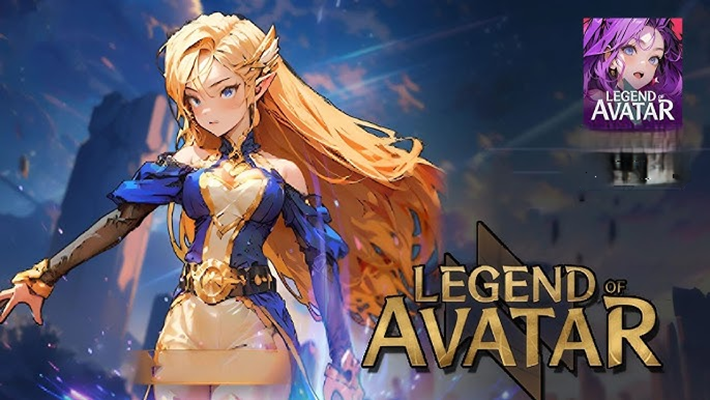
A South Korean gamer spent more than KRW 30 million, roughly $22,500, on Legend of Avatar, a free-to-play mobile title published by BillionaireGames, trusting the loot box probability figures the company publicly displayed. Those figures were later found to be wrong alleged the gamer.
Yongho Park, an avid gamer, is feeling deceived and is seeking a refund for a mobile game after claiming he’s fallen victim to a troubling trend of gacha fraud. This experience has opened his eyes to unsettling tactics used in the world of in-game spending manipulation, an issue that gamers everywhere should take seriously.
Park’s formal complaint, filed with South Korea’s Content Dispute Resolution Committee (CDRC) and shared with KoreaGameDesk along with supporting documentation, doesn’t just describe a billing dispute. It describes a system, one where rigged drop rates, ghost customer support, selective censorship, and a vanishing YouTube video all point in the same troubling direction.
In a message sent to KoreaGameDesk, BillionaireGames emphasized that it operates within the law regarding the issue.
The Numbers That Weren’t Real
At the core of Park’s case is a deceptively simple point. The loot box probability rates BillionaireGames published for Legend of Avatar did not match the rates the game actually used. The company acknowledged the mismatch in correspondence that Park obtained and provided to KoreaGameDesk.
“I made spending decisions based on the numbers they published,” Park told KoreaGameDesk. “Those numbers were wrong. The company admitted that. But when I asked for a mobile game refund, they told me it was a simple change of mind.”
The way this situation is framed is really important in the context of South Korean consumer protection law. If someone simply changes their mind about a purchase, that doesn’t hold much legal significance compared to a case of material misrepresentation, where the facts were misrepresented.
By admitting there’s a difference in the probabilities of loot boxes but then labeling Park’s request as just a personal preference, BillionaireGames is walking a fine line, and it’s becoming increasingly precarious.
In-game spending in mobile titles routinely runs into the tens of thousands of dollars for serious players. But those players assume — reasonably — that the loot box probability numbers on their screens reflect reality. When they don’t, that is not a change of mind. That is gacha fraud.
South Korea’s Legal Net Is Tightening
South Korea is taking the lead in regulating loot box probabilities, making significant changes to ensure fair play for gamers. Starting in January 2025, the amended Game Industry Promotion Act (GIPA) will shift the burden of proof onto game publishers.
This means that companies like BillionaireGames will have to demonstrate they didn’t knowingly misrepresent the drop rates for items in their game, Legend of Avatar. If they fail to comply, they could face serious penalties, including up to two years in prison or fines of up to KRW 20 million.
The Korea Fair Trade Commission (KFTC) is already putting these rules to the test. In December 2025, the KFTC fined developer Webzen KRW 158 million (around $107,000) for deceiving players in its mobile MMORPG, MU Archangel. Webzen presented loot box probabilities suggesting that rare items could drop on the first pull, but in reality, players needed to pull between 50 and 149 times to see those items. The KFTC deemed this a deceptive practice under South Korean consumer protection law. Does that sound familiar?
In another notable incident, Nexon had to issue approximately KRW 2 billion in full refunds after uncovering probability errors in MapleStory Worlds, which also led to the dismissal of a key executive. When major industry players face significant accountability for their mistakes, smaller publishers should expect to be held to the same standards.
On a related note, South Korea’s Korean Fair Trade Commission updated its standard terms and conditions in 2024 to require game providers to process mobile game refunds within 30 days. This rule, along with the expanded powers of the CDRC that took effect in February 2026, means that Park’s case falls within a regulatory environment tightening its grip on the gaming industry.
A Support Team That Didn’t Exist
Beyond the loot box probability problem, Park’s complaint documents operational failures that systematically undermined his ability to play Legend of Avatar as advertised.
He alleges BillionaireGames told users early in the game’s lifecycle that a dedicated customer support team was already operating. According to Park, no such team existed. Players who submitted inquiries during this period received either no response or generic automated replies.
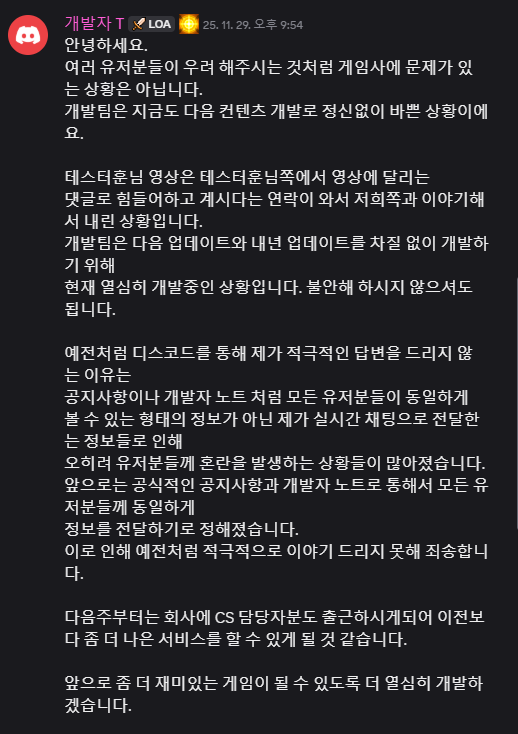
A Discord message from the Legend of Avatar development team, obtained by KoreaGameDesk, appears to confirm this in the company’s own words.
“Starting next week, a customer support staff member will also be joining the company,” the message reads, “so we expect to provide better service than before.”
That announcement arrived well after the game had already launched and taken real money from real players, directly contradicting any claim that support infrastructure was in place from the start. Additionally, Park’s complaint documents a recurring pattern in which the developer’s event rewards differed materially from what players actually received.
For anyone structuring their in-game spending around time-limited events and promised rewards, that discrepancy isn’t trivial. It’s the difference between a worthwhile investment and a money pit.
The Trap Built Into the Servers
One of the more structurally calculated elements of Park’s complaint concerns the server design of Legend of Avatar. He alleges that older, nearly empty servers display a “full” status, mimicking the appearance of a busy new launch. Critically, new character creation is only available on freshly opened servers, precisely where events, rewards, and competitive activity are concentrated.
The message this architecture sends to long-term players is stark: stay on your dying server and miss out, or abandon everything you’ve built and restart, triggering a completely new cycle of in-game spending from scratch. Park characterises this as a deliberate design pattern that generates spending pressure without transparent disclosure. Screenshots of server announcements and user forum posts accompany his complaint as supporting evidence.
Discord: A Courtroom With One Judge
BillionaireGames operates no official public forum. Community communication for Legend of Avatar primarily occurs on Discord, a platform where the company holds unilateral moderation authority.
Park alleges that posts raising concerns about gacha fraud, bugs, and event reward discrepancies, including his own, were deleted. He and others who complained had their ability to chat restricted. He states the deleted posts contained no abusive language or terms-of-service violations; they were bug reports, reward questions, and expressions of concern. Yet they vanished, while posts that reflected more neutral views of the company remained intact.
That pattern, deleting critical content while leaving non-critical content untouched, is the textbook definition of content-driven moderation rather than conduct-driven moderation. Park captured screenshots before deletion. Those images now sit in his evidentiary file.
The company’s own Discord statement frames its withdrawal from the platform as a transparency measure: “Sharing information through real-time chat, instead of official announcements or developer notes that everyone can see equally, has caused confusion among users.” The subtext implied that the channel had become impossible to control, and a quiet exit was preferable to a messy accountability conversation.
The Video That Vanished
Among the most publicly visible elements of this controversy was a video by content creator Testerhoon, a YouTuber with a documented history of rarely removing published work. The video addressed problems with the Legend of Avatar and drew significant negative attention from viewers. It subsequently disappeared.
The Legend of Avatar development team addressed the removal directly in its Discord statement: “Regarding the video by Testerhoon, we were informed that he was having a difficult time due to the comments on his video, so after discussing with him, the video was taken down.”
BillionaireGames presents this as a mutual act of concern. Park reads it differently, as evidence of just how damaging the public reaction was, severe enough to persuade a creator who almost never deletes his work to remove the video. Crucially, the statement discloses neither who initiated the discussion, what was said, nor whether any inducement changed hands.
The Committee the Company Ghosted
Park submitted his formal complaint to the CDRC, a body established under South Korean law to help resolve disputes over digital content. Unfortunately, BillionaireGames failed to respond within the legally required timeframe. As a result, the committee closed the case without any resolution.
Park shared the official closure notice with KoreaGameDesk, confirming that the lack of resolution was directly due to the company’s failure to respond. In contrast, BillionaireGames issued a statement to KoreaGameDesk, claiming that it “responds in good faith to all matters submitted through relevant domestic institutions.” These two documents tell a conflicting story from the same company.
In February 2026, the CDRC gained expanded authority, allowing it to recommend compensation plans for victims who are not even formal parties to a mediation case. Companies must now respond to these recommendations within 15 days. The regulatory framework surrounding the specific type of mobile game refund dispute that Park is pursuing is becoming increasingly robust with each passing month.
Why Every Gamer Should Pay Attention
The allegations in Park’s complaint are still just that—allegations. BillionaireGames has yet to be found liable by any court or regulatory body. However, the verifiable elements, such as the company’s acknowledgment of discrepancies in loot box probabilities, the Discord announcement about the delayed arrival of CS staff, the confirmed Testerhoon video discussion, and the official government closure notice, all suggest that Park’s claims hold weight.
This case goes beyond a single player seeking a refund for a mobile game. It sheds light on the tactics that mobile publishers use to extract money from unsuspecting players. Gacha fraud doesn’t need a grand heist; it simply relies on subtle percentage adjustments that are never audited and can be easily dismissed as technical errors.
For every gamer who has ever hesitated while looking at a gacha screen, questioning whether the advertised percentages actually reflect their chances when they hit pay, Park’s story is a strong indicator that their skepticism is warranted.
Get the hottest news on upcoming game releases, patch updates, and gaming industry trends, stay updated with KoreaGameDesk on Twitter, Facebook, Instagram and Linkedin
More from us:
- Gacha RPGs like Nexon’s Blue Archive and Netmarbles’s Fate Grand Order slapped with R-18 rating for its graphic content
- Exploring the Excitement, Top 10 Upcoming Korean Games in the World of Online Gaming
- Unleash your inner hero with Alterium Shift on Steam’s early access
- Darksword: Battle Eternity VR RPG Showcased at Gamescom
- NCSoft’s Throne and Liberty Revolutionizes Gaming Monetization, Shifts Away from Gacha Systems