

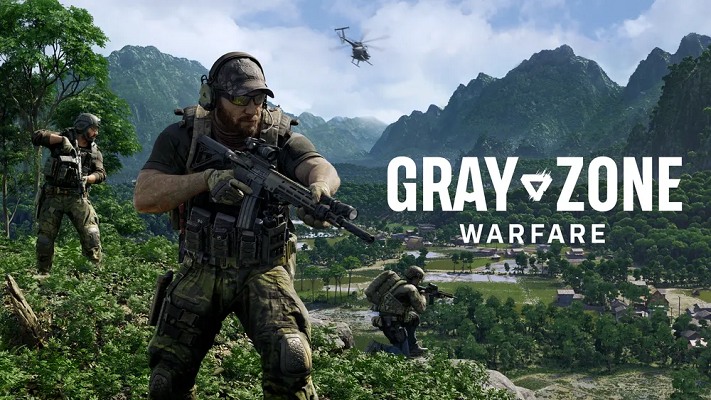
Gray Zone Warfare, a tactical shooter game from Czech developer MADFINGER Games, just recorded a 1,076 percent monthly player surge on Steam after its new Spearhead update, and analysts say the timing, design decisions, and genre positioning make this recovery particularly relevant for competitive gaming scene.
The numbers says it all. Before Update 0.4 launched on March 31, 2026, concurrent Steam players sat below 4,000. Within days, that figure hit 43,770. In the first week alone, 301,540 players logged in to Lamang Island, the game’s fictional 42 km² Southeast Asian quarantine zone, with peak daily active users reaching 174,041. Steam subsequently placed Gray Zone Warfare in its Top 5 Best Selling Games globally.
For a market that treats PC gaming as both competitive infrastructure and social ritual, South Korean players now have a strong reason to look closely at what MADFINGER accomplished. KoreaGameDesk caught up with the team to explore the new update.
Why South Korean Gaming DNA Fits This Game
South Korea built its gaming identity on tactical precision. StarCraft rewired the country’s competitive instincts in the late 1990s; PC bangs, the high-speed, high-spec gaming cafés embedded in every Korean neighborhood, gave that instinct a permanent home.
Today, FPS and RPG titles dominate PC bang rankings, with League of Legends, Overwatch, and Valorant occupying the top slots.
Tactical shooters requiring patience, strategic loadout planning, and systematic map knowledge, the exact pillars that make Korean esports culture elite, align directly with Gray Zone Warfare’s core design.
The game’s PvE-first structure strips out the randomness of player-versus-player chaos and replaces it with deliberate, mission-driven progression. That formula rewards the kind of methodical gameplay Korean gaming culture celebrates at every level, from amateur PC bang sessions to professional esports.
The Early Access label previously deterred Korean players, who tend to commit to polished, well-supported games. The Spearhead update fundamentally changes that calculus.
“Spearhead significantly expands the depth of the game while fine-tuning every key system to improve the overall player experience,” says Tomáš Nawar, spokesperson for MADFINGER Games. “We focused on meaningful changes that push Gray Zone Warfare forward as a whole.”
What Spearhead Actually Rebuilt
MADFINGER Games did not patch Gray Zone Warfare, instead the studio rebuilt it from scratch. The distinction matters analytically.
The quest system now exceeds 250 missions, divided across main missions, side quests, and contracts, each mapped directly to the tactical interface. Previously, players navigated objectives using third-party wikis. That friction is gone.
Furthermore, the economy now pays out cash rewards rather than forcing specific item drops, and faction-based vendor progression unlocks better gear as reputation grows, a clean loop that rewards consistency over luck.
The AI overhaul carries the greatest competitive significance. Enemy units previously tracked players with near-perfect accuracy, making stealth tactically useless.
The Spearhead update corrects that: seven distinct factions now patrol defined zones with logical behavior, silent kills no longer trigger group-wide alerts, and boss characters carry individual voice lines and bodyguard squads. Combat finally functions as intended, a thinking game, not a punishment system.
Additionally, eight new weapons, 380+ weapon parts, and fully reworked ballistics now support a far wider range of viable loadouts, giving players real strategic flexibility rather than forcing convergence on a single meta build.
The Progress Wipe as a Strategic Equalizer
One decision defines Spearhead’s commercial success more than any feature list: MADFINGER Games launched the update alongside a full progress wipe, resetting every player’s progression to zero.
That choice removed the gap between veterans and newcomers. On launch day, every player — regardless of hours logged, started from scratch. Servers filled with players at identical progression stages, the community energy reset alongside the content, and new players encountered a populated, even-footed environment for the first time.
For South Korean players accustomed to entering established live-service games at a disadvantage, this window is structurally rare. The Spearhead update essentially launched a new game inside an existing Early Access shell, and that window remains open now.
Marek Rabas CEO of MADFINGER Games said, “It’s the largest leap in actual game development that we’ve seen so far. And we’re still only 40 percent of the way there. We still have tons more stuff that is getting worked on, in progress, and moving forward.”
Early Access Caution Still Applies
Gray Zone Warfare remains version 0.4, not a finished product. Its Steam review rating sits at roughly 70 percent positive, solid, but not yet definitive. MADFINGER Games has been transparent about the roadmap ahead, and Early Access titles by definition carry uncertainty around scope, timelines, and final execution.
However, the Spearhead update establishes a structural baseline that compares favorably to finished tactical shooters currently on the market. The studio’s willingness to wipe progress, rebuild systems rather than layer patches, and treat the update as a public recommitment to the game’s direction signals a level of developer accountability that matters to any player considering a long-term investment.
The No Man’s Sky and Deep Rock Galactic parallels the global gaming press has drawn are analytically sound — both titles executed similar system-level overhauls after difficult Early Access periods, and both now sit among the most positively reviewed games on Steam.
The Verdict for Gamers
Southeast Asian gaming market ranks as the fourth largest globally, with PC gaming retaining a uniquely powerful cultural role that mobile-first markets cannot replicate. Gray Zone Warfare is a PC-native, tactically demanding, progression-driven game launching its most complete version yet, at the precise moment its servers are most populated and its barrier to entry is at its lowest.
The Spearhead update did not just revive one studio’s flagging Early Access title. It produced a case study in developer accountability and systemic game design that the industry will reference for years. Whether Gray Zone Warfare ultimately earns a permanent spot in South Korea’s PC bang rotation remains an open question, but for the first time since April 2024, that question is worth asking seriously.
Get the hottest news on upcoming game releases, patch updates, and gaming industry trends, stay updated with KoreaGameDesk on Twitter, Facebook, Instagram and Linkedin
More from us:
- Darksword: Battle Eternity VR RPG Showcased at Gamescom
- Silent Road to Turn Night Taxi Shift into Pure Psychological Horror
- Why Tarsier’s REANIMAL Could Be 2026’s Breakout Scare
- Forest Escape: Last Train Makes Its Steam Debut With First Gameplay Trailer
- Shift at Midnight Demo Turns Gas Station Job Into Co-Op Horror